This month, I read both a modern classic and an H.G. Wells book he thought should be a classic. I also read a bunch of books from the 2010s. This is partly because I browsed my library's Libby by using the random sort. The average year is 2006 and the median year is 2015. You can see how a couple of books from decades ago can really affect those numbers.
If you want, check out my Pagebound, where I log my reading daily, and Storygraph, where I catch up at the end of the month.
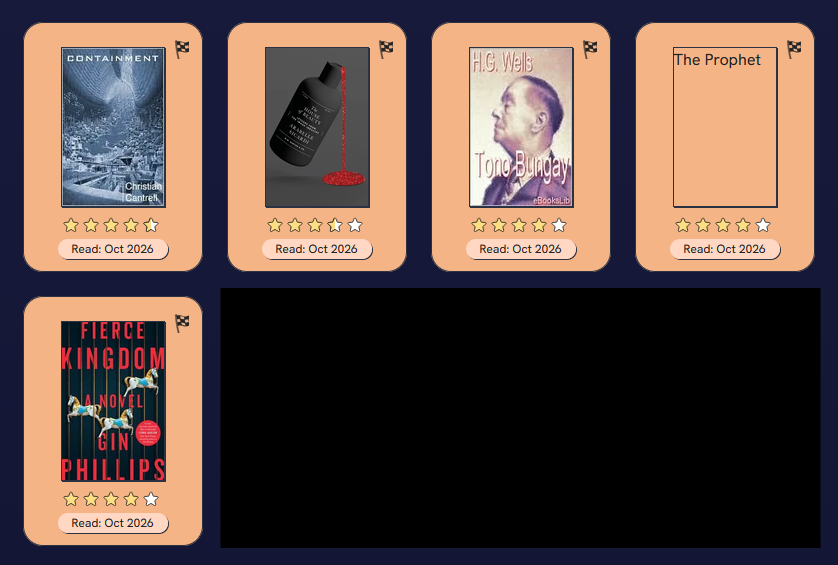
Containment (2010), by Christian Cattrell: I loved Scorpion by the same author. Containment is about an isolated, insulated settlement on Venus. The residents have a generation of children who are about to come of age, and those children have their own ideas. I really liked this.
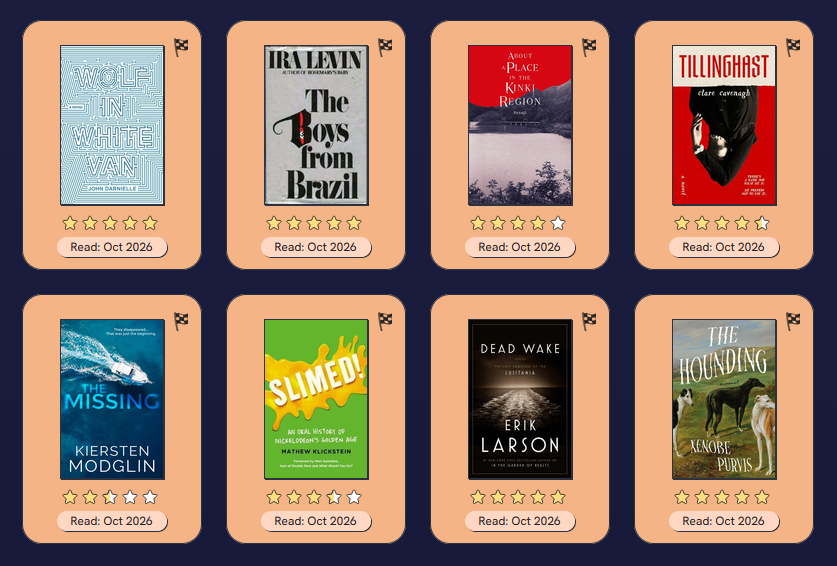
Tillinghast (2026), by Clare Cavenagh: The title character is a grouchy vampire who keeps to himself in a very rural part of Rhode Island. Someone arrives who disrupts his entire way of life. I called this "Man Called Ove but a vampire" and I really liked it
Wolf in White Van (2014), by John Darnielle: I really liked Devil House by Darnielle a.k.a. Mountain Goats, but I loved this book even more. The main character lives in seclusion, and he makes a living with a mail-based TTRPG that he wrote.
Slimed!: An Oral History of Nickelodeon's Golden Age (2013), by Mathew Klickstein: This book contains a ton of great stuff, while also, it is not well written or organized, and many of the execs say weird stuff that was already very out of date by 2013. I liked it but it is very limited by these factors.
The Prophet (2012), by Michael Koryta: I like Koryta and have finished most of his books that I've started. This one is about brothers who survived a terrible family tragedy. One has become sort of a Jack Reacher guy, and the other is a regular suburban dad and football coach. They have to figure out some stuff in order to keep their families safe. I really liked this.
Dead Wake: The Last Crossing of the Lusitania (2015), by Erik Larson: I liked Devil in the White City when I read it 100 years ago, but Dead Wake, to me, is a masterpiece. This is peak reported narrative nonfiction*. Larson sets the stage with tons of background and context, and I learned so much.
The Boys from Brazil (1976), by Ira Levin: This is my first book by Levin, who also wrote Stepford Wives and Rosemary's Baby. I loved this, I found it exciting and fun while also being deadly serious, and with a profound feeling of time, place, and responsibility.
The Missing (2021), by Kiersten Modglin: I hadn't heard of Modglin and grabbed this book because of its interesting sell copy (the paragraph or so summary and teaser, that you read online or on the back of the book). It is totally batshit and makes no sense. That could be fun though.
Fierce Kingdom (2017), by Gin Phillips: This novel is a mass shooting thriller set in a zoo. The main character is a 40ish woman there with her young son. I loved this book, which is about someone who is thinking very hard about what the smartest decision is and then trying to do that.
The Hounding (2025), by Xenobe Purvis: What if the weird local sisters became dogs? Would you categorize that as witchcraft or whatever? This is sort of a historical fugue, and a woman author knows how to really press on the pain points, like how men will grab onto any handy excuse to condemn women who don't want to marry them. I really liked this, while also, be prepared that it is dreamlike and very strange.
About a Place in the Kinki Region (2023, transl. 2026), by Sesuji: I really liked this book, which is like found footage -- this is postmodern! The frame story is a freelance reporter who's passing along a folder of documents in order to find her writer friend who has gone missing. The documents explore a series of weird incidents that coalesce.
The House of Beauty: Lessons from the Image Industry (2025), by Arabelle Sicardi: Sicardi, who is a nonbinary person of color, has long explored the beauty industry's role in doing harm, as well as its complex role in individual people's lives as self care and validation. This essay collection has highs and lows, but I loved the highs, and I learned a lot.
Tono-Bungay (1909), by H.G. Wells: Okay, strangely, Wells felt this was his best book, and I can only say that it definitely isn't. He wrote a similar book that I like a lot more, History of Mr. Polly, the same year as this. It's a somewhat autobiographical novel about a guy who is a scammer basically. It has some nice airplane stuff that I liked. This was very disappointing overall.
- Reported narrative nonfiction means something specific. I'm a journalist, but I rarely do reporting, which is interviewing people, attending events live, finding previously unseen documents like in archives, and other investigative skills. To write a book like this, Larson had to read countless things ranging from single telegrams or postcards up to entire books, talk with many people, corral and organize all that information, and then write a book that tells one cohesive and effective story.I've been a writer for most of my life, and still can't imagine doing all of this.